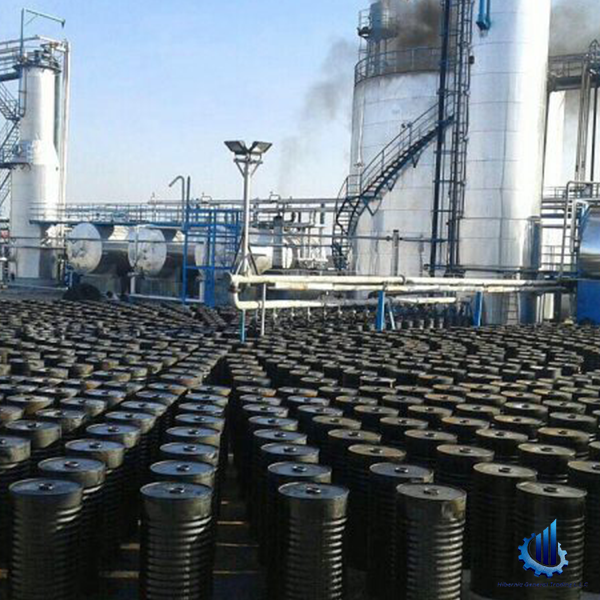
Bitumen Penetration Grade 20/30 is a hard paving-grade bitumen classified according to its penetration value and widely used in road construction and asphalt pavement production. This grade provides an optimal balance between high stiffness and controlled workability, making it suitable for heavy-duty pavements where resistance to deformation and long-term durability are essential.
Definition and Material Characteristics
Bitumen Penetration Grade 20/30 is a petroleum-based bitumen produced from the vacuum residue obtained during the fractional and vacuum distillation of crude oil in modern oil refineries. Through controlled refining processes, the bitumen achieves a penetration range of 20 to 30 (0.1 mm) at 25°C, indicating a relatively hard consistency compared to conventional paving grades.
Penetration grade bitumens are specified primarily by their penetration and softening point values, and their designation is based solely on the penetration range. Bitumen 20/30 exhibits a thermoplastic behavior, meaning it softens at high temperatures and hardens at lower temperatures. This temperature–viscosity relationship is a critical factor in determining performance parameters such as adhesion to aggregates, rheological behavior, durability of asphalt mixtures, and suitable mixing and application temperatures.
Once mixed with aggregates, Bitumen 20/30 provides strong bonding, cohesion, and structural stability to the asphalt mix.
Physical and Performance Properties
Bitumen Penetration Grade 20/30 is characterized by:
-
Relatively low penetration, indicating high stiffness
-
Adequate softening point for improved thermal resistance
-
Excellent adhesion to mineral aggregates
-
Good rheological performance under traffic loads
-
Reduced susceptibility to rutting and permanent deformation
-
Stable performance in warm and hot climatic conditions
These properties make this grade suitable for structural asphalt layers exposed to heavy traffic.
Meaning of Penetration Grade 20/30
The penetration grade is determined by measuring the depth that a standard needle penetrates the bitumen sample under controlled conditions in accordance with ASTM D5 or EN 1426.
A penetration value of 20/30 indicates:
-
Higher stiffness compared to softer grades such as 60/70 or 80/100
-
Improved resistance to deformation and rutting
-
Better performance under high traffic loads and elevated temperatures
This grade is particularly suitable for warm to hot climates and high-load pavement designs.
Applications of Bitumen Penetration Grade 20/30
Bitumen Penetration Grade 20/30 is commonly used in:
-
Road construction and rehabilitation projects
-
High-traffic highways and expressways
-
Asphalt base courses
-
Wearing courses requiring higher stiffness
-
Hot mix asphalt (HMA) production for structural pavement layers
Its mechanical strength allows pavement designers to optimize layer thickness while maintaining long service life.
Quality Assurance, Safety, and Standards
High-quality Bitumen Penetration Grade 20/30 is manufactured under strict quality control systems, including:
-
Continuous production monitoring
-
Batch-wise laboratory testing
-
Independent inspection of quality and quantity during loading
-
Issuance of batch test reports prior to shipment
This grade is produced in compliance with:
These controls ensure consistent quality, safe handling, and full conformity with international specifications.
Technical Specification – Bitumen Penetration Grade 20/30
| Property |
Test Method |
Unit |
Specification |
| Penetration @ 25°C |
EN 1426 |
0.1 mm |
20 – 30 |
| Softening Point |
EN 1427 |
°C |
53 – 65 |
| Kinematic Viscosity @ 135°C |
EN 12595 |
mm²/s |
≥ 530 |
| Flash Point |
EN 22592 |
°C |
≥ 240 |
| Solubility in CS₂ |
EN 12592 |
wt % |
≥ 99 |